31/10/2007

Infografreaks IV

Alberto Cairo has uploaded again several projects of his pupils on his blog.
Tis time, the topic was the earthquake of Pisco, Peru, which happened some months agop. All the works are clean and with the high usual level. An example on how important is to have a good teacher.
It's not the first time I speak about Chapel Hill, and how there are plans to have adecuate university studies about graphics and design there, and how hard is to find where to study these disciplines in Spain (don't know how is the situation abroad). We don't have a career or even a "branch" if you want to guide your career to an Infographics Department.

Maybe the University of Navarra (private) could be the best way in order to do it, but also there you ahve to "struggle" to learn: you've got the join the Malofiej team as staff (an excelent place to learn) and there is an optative about infographics (where there have been teachers as Jaume Serra, Zarracina and Baptista and now Josemi Benitez). Tehre's also a subject called Visual Communication in Journalism (Mario Tascón and Tomás Ondaraa are former teachers and also Miguel Urabayen).
It's not too much, Just two subject and both optatives. But much more than other places in Spain. And laearning about infographics is not important just for those who want to be infographics artist, but also if you want to be journalist, cause infographics are gonna be part of your job.

28/10/2007

To sign or no to sign

One of teh comments of teh post "National Geographic hires in spanish or how success killed Spain" in the spanish edition of this blog talked about signing graphics.What thinking do we follow to sign some graphics with our name and the name of the publication on others?. The anonymous comment talked about some cases I don't agree, as signing if we're proud of the graphic and using the media name when we're not.
It would we interesting to know which are your prodcedures on these cases. Do you use always the same reasons or each infographics artists of the department decides when to sign?. To start the topic, these are my reasons to sign a graphic with my name:

A. When there is a personal responsability on the graphic. The graphci is that way because a particular infographic artist, and not other, have done it so. It's not just applying styles, like charts (most of the times)

B. We use the name of the publication when there's an "imposition" to do the graphic in a way we don't agree, but the "high spheres" decide to do that way.

C. We sign as infographics department when the graphic is a work of all (or almost all) the members of the department.

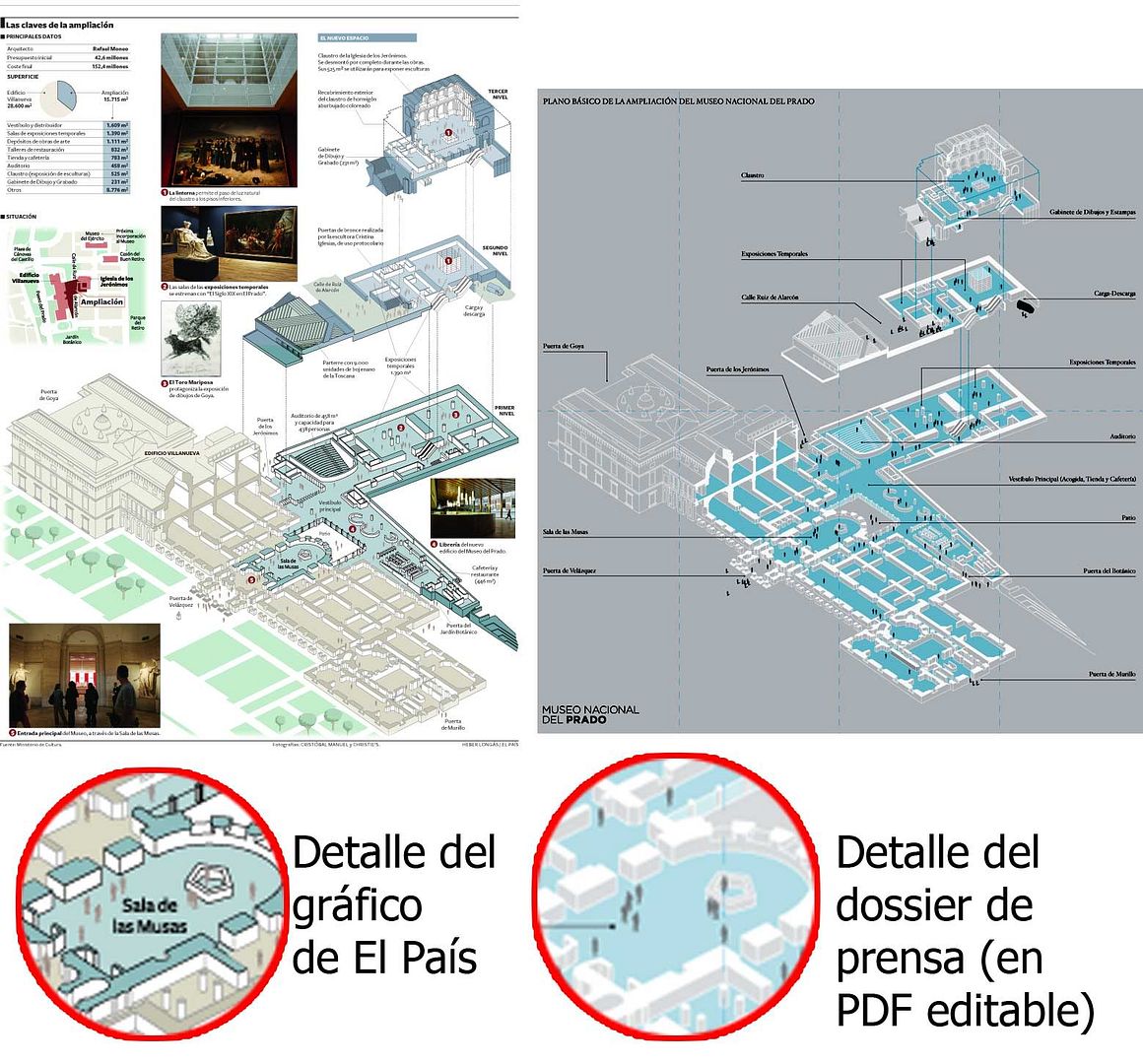
D. We don't sign with particular names when we use important pieces of the graphics coming from press dossiers (3d, or PDFs), avalaible for its use, but not produced by the department, completely or partially. Of course, the source appears in the graphic.
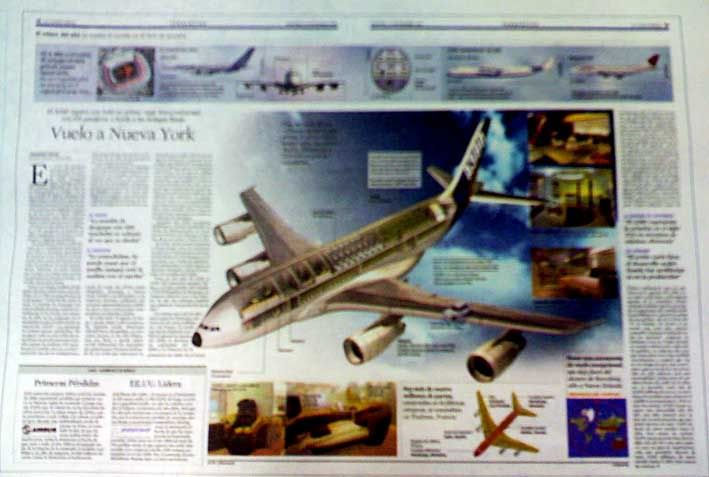
This is something that doesn't happen always,as in this graphic by EL PAIS, signed by an infographics artist. CLICK TO ENLARGE


Of course, I would have forgotten a lot of cases. But we always use the responsability as teh key to sign or not a graphic. For good and bad. Signing is not a prize, is not something to show that it was you who made that cool stuff, is pointing yourself as responsibel of the stuff.D It's not a problem of good and bad graphics, of big ones or small ones.
It would be interesting to know which cryteria do you use on your departments. Is sharing knowledge how we learn.

24/10/2007

As in Boston


I didn't go. But taking a little from here and other little from there, is possible to have a "little reconstruction" of what happened in Boston.
In the Summit web we have avalaible some PDFs and videos (coming soon) about some of the conferences. DAnyway, we'll put the focus upon those about graphics.

JAVIER ZARRACINA
Paco Oca uploaded on his blog some days ago three videos with Javier's conference. And Javier hmself uploaded on his personal web a link with a PDF of it..

TIPS AND TRICKS
Most of the are very basic, but there's always a little detail we haven't notices and could be very useful. I think the real workshops were better than this, but at least we have something
- Illustrator
- Photoshop
- Flash

ONLINE
We had two conferences about online, one focused on designm but also useful for graphics, with Jean Crandall (Washington Post) and Kelli Sulivan (LA Times). Kelli Sullivan's conferences about the project Altered Oceans is avalaible in PDF.
The other one, focused in graphics, had Len de Groot and Rafa Höhr talking about graphics form print to mutimedia. Both are uploaded.
- Len de Groot
- Rafa Höhr

GRAPHICS BRAINSTORMING
Archie Tse (NY Times) and Javier Zarracina took this section. Archie's PDF with some statistical works from NYT is amazing.

17/10/2007

National Geographic hires in spanish or how success killed Spain

Two of the big ones of the world of infographics, Fernando G. Baptista, former El Correo, and Alejandro Tumas, from Clarín, have been hired by National Geographic, which spanish-talkers staff grows, cause they already have Juan Velasco ads Graphics Director.
The problem of the infographics brain drain is something worrying in Spain, where, after suffering these lasts year the american adverture of Cairo, Xocas, Zarracina and Baptista, have their referal infographics media "attacked", as were elmundo.es for online and El Correo dfor print.
The lack of these 'geniuses" in Spain in not just a harm for themselves, but also because new values have lost much of teh great potential teachers tehy could have. When Cairo take his way to Chapel Hill, left his 'pupil' Xocas at charge, but now he's gone too.
The infographics level in Spain is descending, maybe cause sucess is finally killing us.

15/10/2007

News from Boston

All those who can't (as myself) be these days at the SND Summit in Boston, could at least be glad to have an impressive coverage from SND Update blog, telling every detail at the very moment it happens.

09/10/2007

Publico, two weeks later

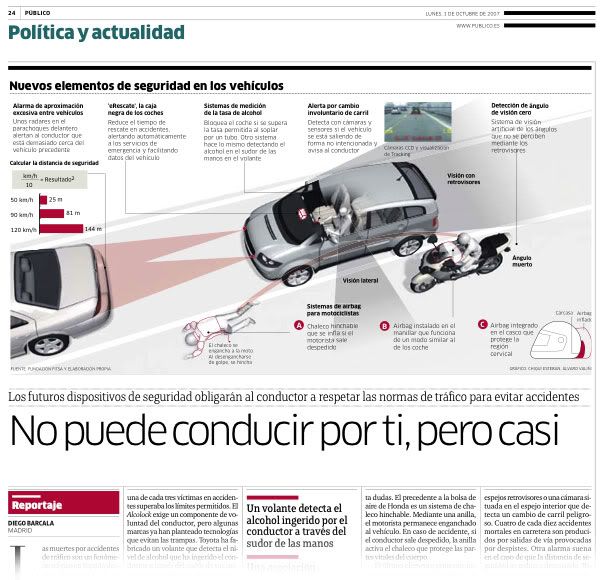
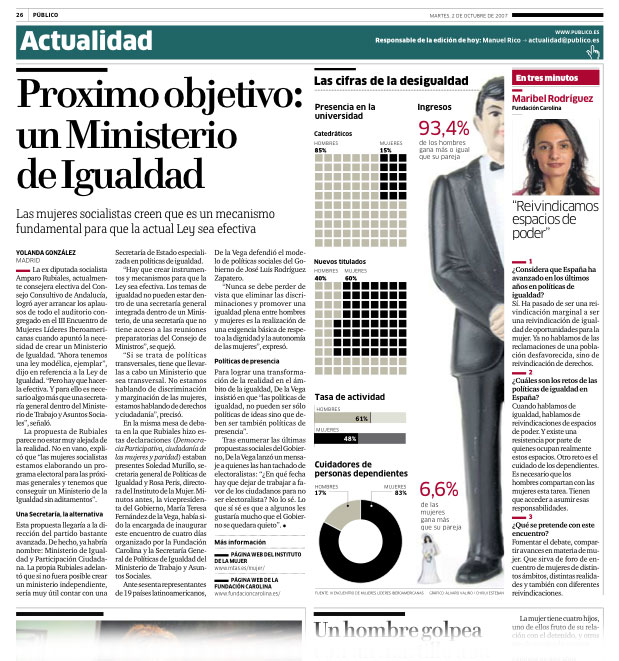
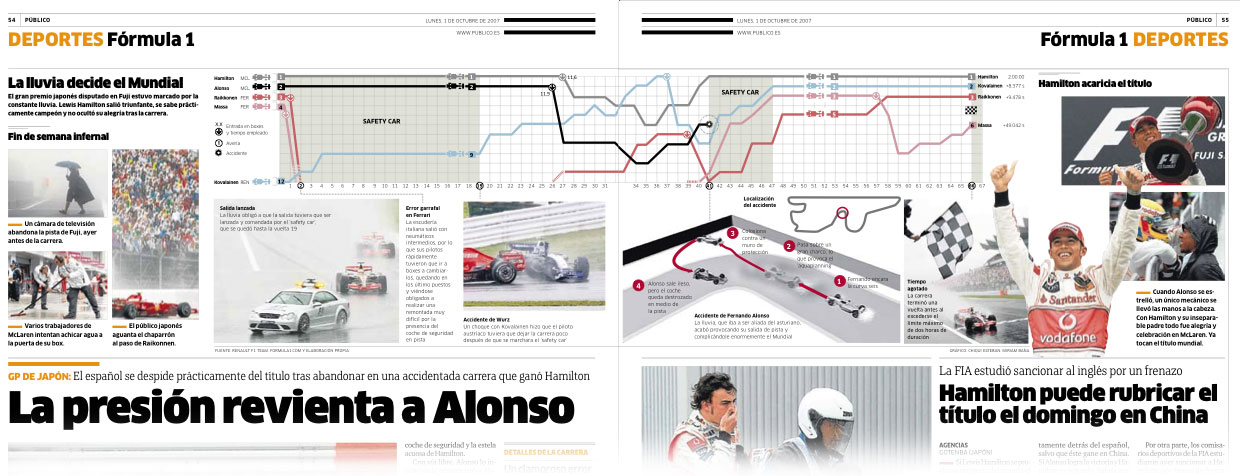
Two weeks from the first issue of Público and we already have a considerable amount of graphics to judge. At the moment, we are three in the department. Álvaro Valiño, former La Voz de Galicia, Miriam Baña, coming from El Economista, and myself. We have two other people, Susana and Fran, helping with the rush of the frists weeks. As I commented, we're not still at 100%, but it's just a matter of time.
Focusing on the graphics, these are some of the things we're having on the firsts issues.


As I hope you could see, our will is to do graphics which explain the news, on a clear and clean way. Using color with a purpose, and helping the reader to visualize teh information. In sections as Science and Tech we're making an effort to make accesible the complicated concepts that we have to handle on those informations.We still have a long way ahead, but we hope we could go further and further.

Some graphics are uploaded everyday at Público.es, associated to the corresponant news. As commented, going online is just a matter of time.

When graphics don't say all the truth

An article published in september at O'Reilly Radar complained about this ¡NY Times graphic about the increase of the houses value


The complaint comes from the fact that, not having a scale form zero, the valeu looks like been multiplied several times, when it's "just" really the double.
The problems of the scales from zero has been always on the infographics. If you use it, most of the times you can't see the evolution, and if you start from above, the scale is not real. Hard solution. But The Washington Post, and I suppose that several like them, use an "intermediate" solution for this problem.
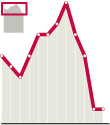
They include a sort of "locator" of teh evolution, bars or whatever, drawing the graphic with scale from zero, and having the big graphic for the intersting part. Something like this lttle example on the right.
So, you can see how it increases or decreases and, at the same time, you don't loose the scale. Anyway, this particular case of NY Times has less excuses because, as the value is the double, the difference is visible. Not so espectacular, but visible. And telling the truth. But, let he without sin throw the first stone.
Via XBlog

05/10/2007

Awarded at ÑH04


Público (the portuguese one)El Economista and Superdeporte has been awarded as teh best designed newspapers on Spain and Portugal at the ÑH04. To take a look to the complete list of awarded, you can visit the web of the SND Spanish Chapter.
If we focus on graphics, teh awarded have been the following:

PRINT
Breaking news
SILVER
La Voz de Galicia. Decibelios. 04/03/07
La Voz de Galicia. Elecciones 27-M. 30/05/07
MENTION
ABC. Accidente aéreo en São Paulo. 19/07/07
La Voz de Galicia. El fondo del mar guarda... 25/10/05

Features
SILVER
Expresso. Tudo pronto no TGV. 28/10/06
Expresso. Nem um só minuto de paz. 07/10/06
Expresso. A 35ª avenida mais cara do mundo. 11/11/06
MENTION
ABC. El desastre del Hindenburg. 06/05/07
El Periódico de Catalunya. El món del cargol. 01/07/07
Levante-EMV. El voto en las elecciones autonómicas. 12/05/07

Portfolios
SILVER
El Economista
MENTION
El Mundo
El Mundo (Magazine). Tintín
El Periódico de Catalunya

ONLINE
IOnfographics and use of multimedia
SILVER
Consumer.es. Portfolio de reportajes
TV3.cat. Guernica: Pintura de guerra.

And also we have the dates and place for the next ÑH Summit. It will take place between November 21th and 23th in Barcelona, organized by SND-E and La Vanguardia.

04/10/2007

Free Burma


Free Burma!


International Bloggers' Day for Burma on the 4th of October

02/10/2007

La Vanguardia: New design, same spirit


Today has been released the new design of the catalonian newspaper La Vanguardia, a new InnovAtion project, on which have participated, adding to the newspaper staff, people like Carlos Soria, Juan Antonio Giner, Juan Señor, Javier Errea, Javier Zarracina, Marta Torres, Claude Erbsen or Thomaz Souto Correa. A redesign trying to look for a more modern concept but keeping the same spirit as alaways.
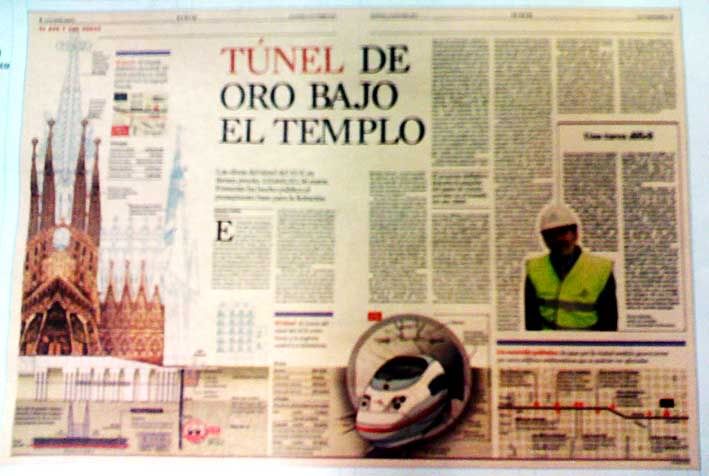
If we focus on gaphics, the idea can't be better. A project brought by two of the biggest geniuses of infographics, as Jaume Serra and Javier Zarracina. And these are the results:
(Images from Innovations in newspapers and Maquetadores)


A first view the ambition is very clear, the bg bet for graphics in this newspaper where this ¿genre? loooked slept for years. The Jaume Serra's own style is entering in the paper, and that's very good news. I'll keep an eye on the evolution, because the return of Jaume is one of the biggest news for infographics at the moment.

Latins and Washington Post, big winner of NAO2Q


This graphic, made by Robinson Choquetaype has been awarded as Best of Show at NAO 2Q, organized by NAO. In this editions, latin infographics artists han been specially notorious, something more important if we know that NAO is almost full of USA members.
This is the complete awards list:
BEST OF SHOW
Chan Chan, Robinson Choquetaype (La República, Perú)

INTERACTIVE
¿Cuánto sabes sobre la historia del deporte, Nicolás Ramallo, Manuel González and Ana Landi (El Universal, Venezuela)

ONLINE
Copa América, Omar Hernández (Asesor Creativo, Venezuela)

MULTIMEDIA
St. Louis Blues, Brian Williamson (St. Louis Post-Dispatch, USA)


ILLUSTRATION
Web 2.0, amateurs at work, Martin Gee (San José Mercury News, USA)


LARGE GRAPHIC
Lindbergh, el espíritu de San Luis, Juan Pablo Bravo and Natalia Herrera (El Mercurio, Chile)


MAP
South Florida Foreclosures, Cindy Jones-Hulfachor (South Florida South Sentinel, USA)


CHARTS
Politician's fighting words, Laura Stanton and Karen Yourish (The Washington Post, USA)


SMALL GRAPHIC
The Bad vs. the Good, Patterson Clark and Brenna Malone (The Washington Post, USA)


ONE COLUMN GRAPHIC
Dog's intelligence, Patterson Clark (The Washington Post, USA)

To take a look to teh compelte gallery,visit NAO2Q gallery